
Free printable schedule and bracket · Pool play
16 team pool play schedule and bracket
16 teams in pool play, also called round robin pools: four pools of 4, two pools of 8, two pools of 5 and a pool of 6, or four pools of 3 and a pool of 4, each pool a round robin, then the top 2 in each pool seeded into a single elimination playoff.
Sixteen teams: four pools of 4 is the classic: 24 pool games, 3 games each, then the top 2 in each pool into an 8-team playoff with no byes. Two pools of 8 doubles the pool games; three or five pools leave the pools uneven.
Free to build and preview. $29 one-time to publish. The PDF is free, no sign-up.
- 4pools, the usual split
- 3–6games per team
- 31games: 24 in pools, 7 in the playoff
- 8teams in the playoff (top 2 per pool)
Your options
Every split TourneyPage allows for 16 teams.
| Split | Pool games | Games per team | Playoff | Total games | Rounds |
|---|---|---|---|---|---|
| Four pools of 4 (usual) | 24 | 3–6 | 8 teams, 7 games | 31 | 3 + 3 |
| Two pools of 8 | 56 | 7–9 | 4 teams, 3 games | 59 | 7 + 2 |
| Two pools of 5 and a pool of 6 | 35 | 4–8 | 6 teams, 5 games, 2 byes | 40 | 5 + 3 |
| Four pools of 3 and a pool of 4 | 18 | 2–7 | 10 teams, 9 games, 6 byes | 27 | 3 + 4 |
The pools
Four pools of 4: 24 games, every pairing once.
Standings
Pool A
| Rank | Team | W | L | +/− |
|---|---|---|---|---|
| 1 | x–Team 1 | 0 | 0 | 0 |
| 2 | x–Team 8 | 0 | 0 | 0 |
| 3 | Team 9 | 0 | 0 | 0 |
| 4 | Team 16 | 0 | 0 | 0 |
Pool B
| Rank | Team | W | L | +/− |
|---|---|---|---|---|
| 1 | x–Team 2 | 0 | 0 | 0 |
| 2 | x–Team 7 | 0 | 0 | 0 |
| 3 | Team 10 | 0 | 0 | 0 |
| 4 | Team 15 | 0 | 0 | 0 |
Pool C
| Rank | Team | W | L | +/− |
|---|---|---|---|---|
| 1 | x–Team 3 | 0 | 0 | 0 |
| 2 | x–Team 6 | 0 | 0 | 0 |
| 3 | Team 11 | 0 | 0 | 0 |
| 4 | Team 14 | 0 | 0 | 0 |
Pool D
| Rank | Team | W | L | +/− |
|---|---|---|---|---|
| 1 | x–Team 4 | 0 | 0 | 0 |
| 2 | x–Team 5 | 0 | 0 | 0 |
| 3 | Team 12 | 0 | 0 | 0 |
| 4 | Team 13 | 0 | 0 | 0 |
x–in a playoff spot. Top 2 in each pool advance to a single-elimination playoff. Ties go to head-to-head, then point differential, then points allowed.
Schedule
Round 1
- 1Pool ATeam 1v.Team 16
- 2Pool ATeam 8v.Team 9
- 3Pool BTeam 2v.Team 15
- 4Pool BTeam 7v.Team 10
- 5Pool CTeam 3v.Team 14
- 6Pool CTeam 6v.Team 11
- 7Pool DTeam 4v.Team 13
- 8Pool DTeam 5v.Team 12
Round 2
- 9Pool ATeam 9v.Team 1
- 10Pool ATeam 16v.Team 8
- 11Pool BTeam 10v.Team 2
- 12Pool BTeam 15v.Team 7
- 13Pool CTeam 11v.Team 3
- 14Pool CTeam 14v.Team 6
- 15Pool DTeam 12v.Team 4
- 16Pool DTeam 13v.Team 5
Round 3
- 17Pool ATeam 1v.Team 8
- 18Pool ATeam 9v.Team 16
- 19Pool BTeam 2v.Team 7
- 20Pool BTeam 10v.Team 15
- 21Pool CTeam 3v.Team 6
- 22Pool CTeam 11v.Team 14
- 23Pool DTeam 4v.Team 5
- 24Pool DTeam 12v.Team 13
The playoff
Top 2 from each pool: a 8-team bracket, 7 games.
Playoff
QuarterfinalsGames 1–4
- 111st in poolv.82nd in pool
- 241st in poolv.52nd in pool
- 321st in poolv.72nd in pool
- 431st in poolv.62nd in pool
SemifinalsGames 5–6
- 5Winner of Game 1v.Winner of Game 2
- 6Winner of Game 3v.Winner of Game 4
FinalGame 7
- 7Winner of Game 5v.Winner of Game 6
Pool winners take the top seeds, runners-up the next ones, ordered against each other by the same tiebreakers the standings use. Byes go to the top seeds, and the engine keeps two teams from the same pool apart in the first round when the bracket allows it. In TourneyPage the playoff builds itself when the last pool game is final.
Standings
How each pool sorts itself.
Win percentage first. When two teams are level, TourneyPage goes down the list: head-to-head, then point differential, then points allowed. Sports scored in sets use set percentage in place of point differential. A tie in a game is allowed, the organizer can reorder the tiebreakers, and the standings say which one placed a team when it mattered. The line in each table marks the playoff cutoff.
How long it takes
Roughly how long 16-team pool play runs.
About 13 hours 20 minutes. 31 games in 16 rounds of play across 2 fields.
Arithmetic, not a schedule: it ignores breaks and assumes every field stays busy. In TourneyPage you type the actual times and courts, and they show on the page.
That's the usual split, four pools of 4: 3 pool rounds and a 3-round playoff have to follow one another, so the day can't be shorter than 6 waves of games.
Printable
Print it, or run it live.
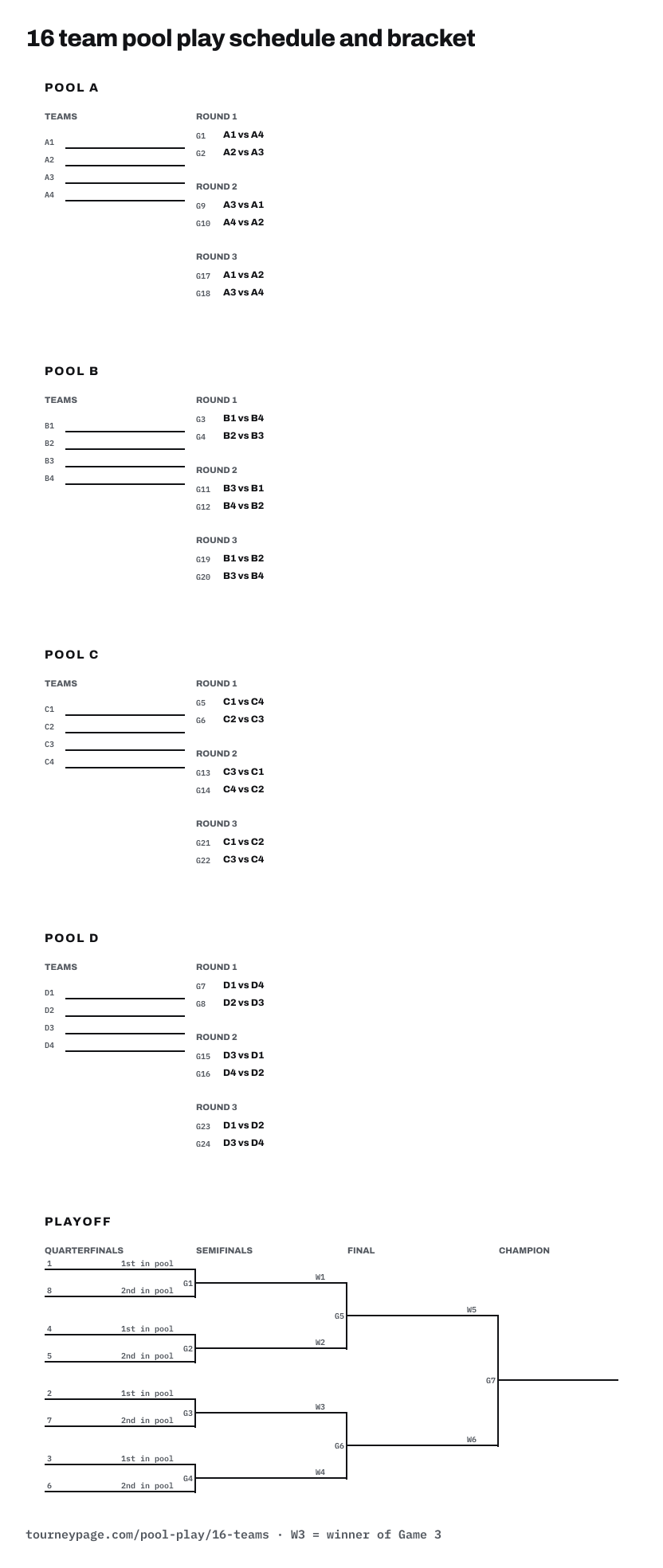
The PDF is US Letter, landscape: a page per pool with a numbered key and blank lines for the team names, every game numbered, then the playoff bracket on its own page. Free, no sign-up, nothing on it but the schedule and this page's address.
Or run it live. The live version keeps every pool's standings, takes scores from a phone, builds the playoff from the final standings on its own, and shows the next games on top. Up to 32 teams per division. Free to build and preview; $29 one-time to publish.
Questions
Questions about 16-team pool play.
How does pool play work with 16 teams?
The 16 teams are split into pools (four pools of 4, two pools of 8, two pools of 5 and a pool of 6, or four pools of 3 and a pool of 4) in snake order, so the strongest seeds land in different pools. Each pool plays a round robin, standings sort each pool, and the top 2 in every pool are seeded into one single elimination playoff. In TourneyPage the playoff builds itself the moment the last pool game is final.
How many games are in 16 team pool play?
Four pools of 4 is 24 pool games plus a 8-team playoff of 7, 31 in all; two pools of 8 is 56 pool games plus a 4-team playoff of 3, 59 in all; two pools of 5 and a pool of 6 is 35 pool games plus a 6-team playoff of 5, 40 in all; four pools of 3 and a pool of 4 is 18 pool games plus a 10-team playoff of 9, 27 in all. The usual split, four pools of 4, is what the pages above draw.
How many games does each team get?
Four pools of 4: at least 3, at most 6; two pools of 8: at least 7, at most 9; two pools of 5 and a pool of 6: at least 4, at most 8; four pools of 3 and a pool of 4: at least 2, at most 7. The minimum is the pool games a team is sure of; the maximum is a team from the biggest pool that goes all the way through the playoff.
How are the playoff seeds decided?
Pool winners take the top seeds, ordered against each other by the same tiebreakers the standings use; runners-up fill the seeds after them, and so on. Byes go to the top seeds. The engine then arranges the first round so two teams from the same pool don't meet again straight away, when the bracket allows it. The playoff above shows 1st and 2nd in pool, because which pool a seed comes from depends on the results.
What if teams tie in a pool?
By win percentage first, then head-to-head, then point differential, then points allowed, for sports scored in points; sports scored in sets, like volleyball and pickleball, use set percentage in place of point differential. The organizer can reorder the list, ties in a game are allowed, and the standings say which tiebreaker placed a team when one was needed.
How long does 16 team pool play take?
About 13 hours 20 minutes with 31 games at 50 minutes each on 2 fields. That's the usual split; change the game length and the number of fields above to match your event. TourneyPage doesn't schedule the games for you; you type the times and courts you decide on, and they show on the page.
Can I print this or run it live?
Both. The PDF is free, with no sign-up: a page per pool and the playoff bracket. "Run pool play live" opens the TourneyPage builder with pool play already chosen and the usual split suggested; add the team names, and the standings, schedule, and playoff take care of themselves as scores come in. Free to build and preview, $29 once to publish.
Other sizes
Pool play for 6 to 16 teams.
How pool play works · Single-pool round robin schedules · Free printable brackets · Game counts for every format · Sports that usually run pools: Pickleball, Basketball, Volleyball, Flag football, Soccer, Softball, Baseball, Kickball, Table tennis (ping pong)
Make your tournament feel official.
Free to build. $29 one-time to publish. One link your players, parents, and fans will actually open.